Claude Fable 5 Suspended: What Happened and How to Fix Your Workflows Now

Cerme
CEO & Local SEO Expert
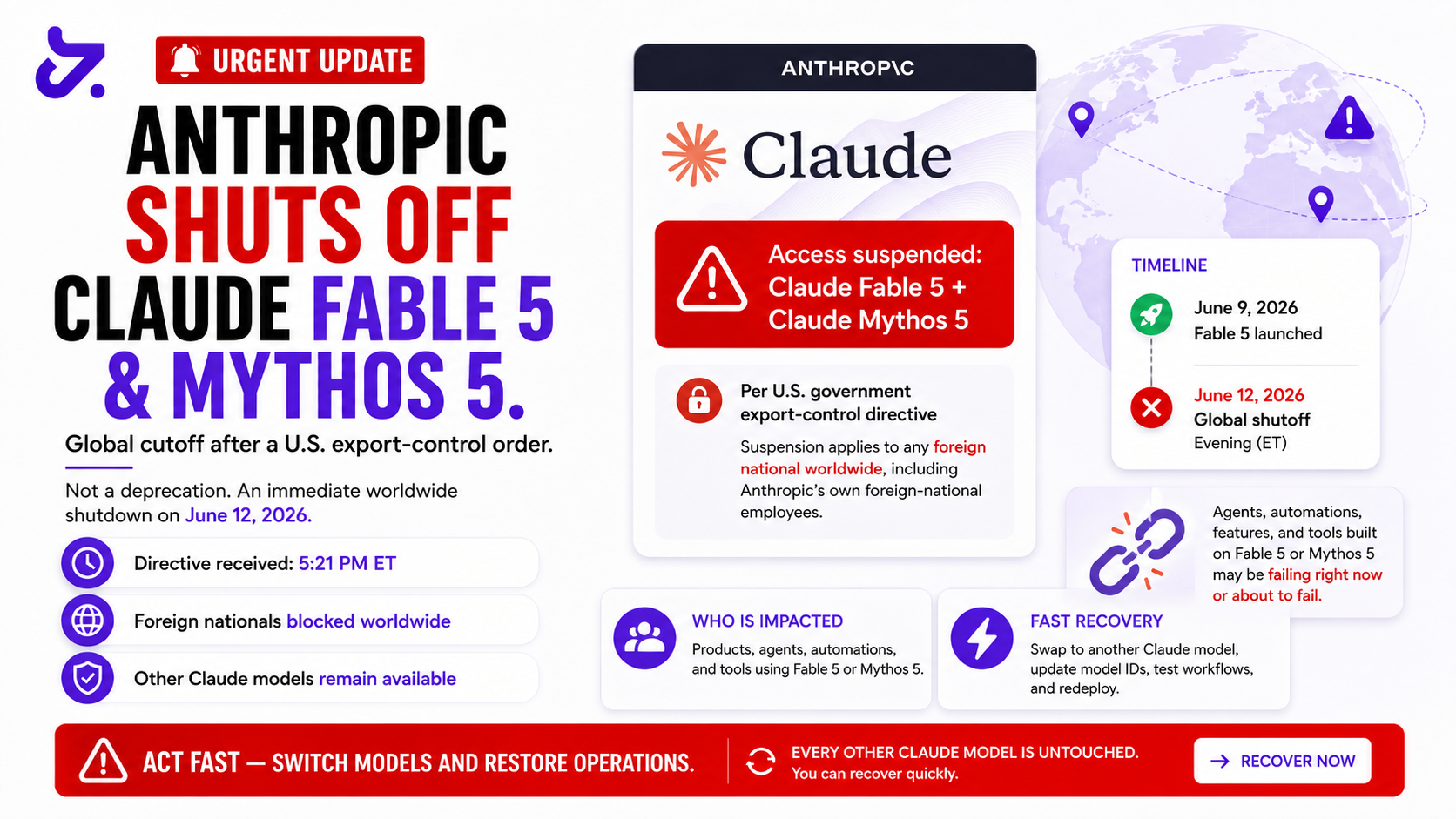
On the evening of June 12, 2026, Anthropic abruptly disabled access to Claude Fable 5 and Claude Mythos 5 for every user on the planet. Not a soft deprecation, not a rolling sunset — an immediate, global shutoff of its two most powerful models, just three days after Fable 5 launched on June 9.
The reason isn't a billing problem or an outage you can wait out. According to Anthropic's own statement, the company received a US government export-control directive at 5:21 PM ET that day, citing national security authorities, ordering it to suspend access to both models for any foreign national — anywhere in the world, including Anthropic's own foreign-national employees.
If you built anything on Fable 5 — an agent, an automation, a product feature, an internal tool — it is failing right now or about to. The good news: the fix is straightforward, every other Claude model is untouched, and you can be back to normal operations in minutes. This post walks through exactly what happened and the precise steps to recover.

What Is Happening
Here are the confirmed facts, sourced directly from Anthropic and major outlets including CNBC, TIME, and Fortune:
- What was disabled: Claude Fable 5 and Claude Mythos 5 — Anthropic's two newest, most capable models.
- When: The directive arrived June 12, 2026 at 5:21 PM ET; the models went dark for all customers the same evening.
- Why a global shutoff: The order only targets foreign nationals, but Anthropic cannot filter users by nationality in real time. The only compliant option was to disable both models for everyone, worldwide.
- The stated trigger: Anthropic says the government believes it became aware of a method for "jailbreaking" Fable 5 — specifically, asking the model to read a specific codebase and fix software flaws. Anthropic describes this as a narrow, non-universal technique and says it has only received verbal evidence so far.
- Anthropic's position: The company believes this is a misunderstanding, publicly disagrees with the action, and says it is "working to restore access as soon as possible."
There is no published restoration date. Treat this as an open-ended outage, not a quick blip.
Who Is Being Affected
This hits a specific group hard and leaves most of the Claude ecosystem untouched:
- Anyone who hardcoded
claude-fable-5orclaude-mythos-5in API calls, scripts, or playground configs — those requests now error out. - Workspace and Co-work users who set Fable 5 as their active model — prompts and tasks fail until the model is changed.
- Products advertising "Powered by Claude Fable 5" — both the feature and the marketing claim are now broken.
- Scheduled jobs, retry queues, and eval pipelines still pointed at the suspended models — these fail silently and can stack up errors.
Who is NOT affected: Everyone on every other Claude model. Opus 4.8, Sonnet 4.6, and Haiku 4.5 remain fully available and stable.
Why This Happened
This is not a performance, safety-recall, or commercial decision by Anthropic. It is a compliance action in response to a government export-control order issued under national security authorities.
The chain of events, as reported: a jailbreak concern — reportedly surfaced via another company's claim — reached the government, which issued the directive restricting foreign-national access. Because nationality-based real-time filtering isn't feasible at the model layer, blanket suspension became the only way to comply. Anthropic has framed the underlying concern as narrow and is contesting it while pursuing reinstatement.
The practical takeaway for you: the cause is regulatory and outside your control, the timeline is uncertain, and the responsible move is to route around it now rather than wait.
What This Means for Your Business
If Fable 5 was in your critical path, the consequences are immediate:
- Failed requests and broken features anywhere a suspended model ID is still referenced.
- Stalled automations and agents that depended on Fable 5's reasoning.
- Customer-facing breakage for products that exposed Fable 5 directly.
- Quiet cost and reliability drift if fallback logic was never built and requests simply die.
The fix is a model swap plus a small amount of config hygiene — and for many teams, Opus 4.8 will close most of the capability gap. If you are building on Claude in the first place, our guide to using Claude Code to build real production systems shows why config-driven model selection matters before a disruption like this hits.
What You Should NOT Do
- Don't wait for Fable 5 to come back. There's no ETA. Switch now and re-enable later if you choose.
- Don't leave
claude-fable-5/claude-mythos-5hardcoded anywhere "just in case" — every lingering reference is a live failure point. - Don't panic-migrate to a different provider as your first move. Other Claude models are available and your prompts will mostly transfer with minimal changes.
- Don't forget the background jobs. The errors you don't see — cron jobs, retry queues, eval runs — are the ones that bite later.
- Don't keep marketing "Powered by Fable 5" while the model is offline.
Recovery Action Plan
Follow these steps in order:
- Switch your active model in the UI. In your workspace settings (e.g., Claude Co-work), change the active model from Fable 5 to Opus 4.8, or set it to Default, so prompts and tasks stop failing.
- Find and replace model IDs in code. Search your codebase for
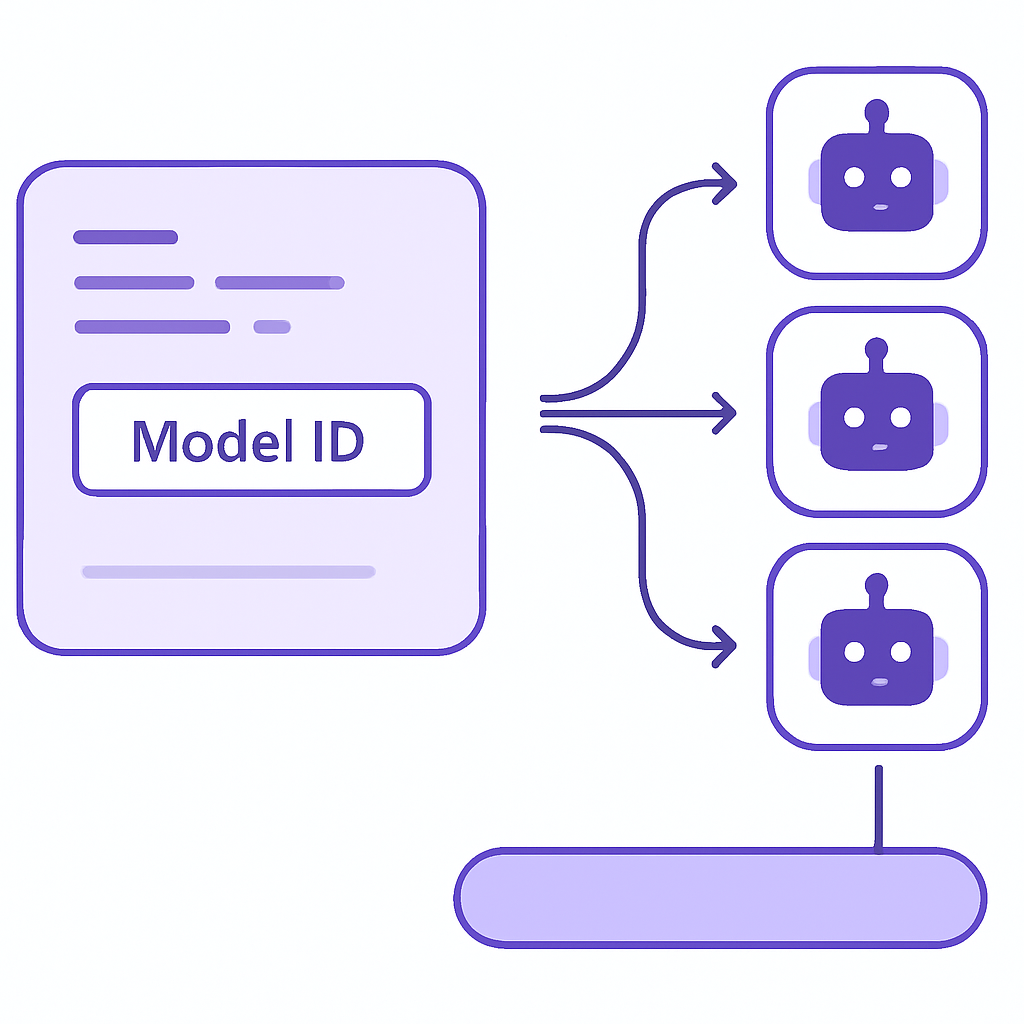
claude-fable-5andclaude-mythos-5and substitute:claude-opus-4-8for agentic workflows and high-reasoning tasks;claude-sonnet-4-6for standard production traffic (roughly 1.7× cheaper blended cost);claude-haiku-4-5for classification and routing. - Update API configs, scripts, and playgrounds. Point feature flags, environment configs, and saved playground presets at available models so nothing still calls a suspended one.
- Move model selection into configuration, not hardcoded values. This lets you swap models in the future without a code release.
- Audit background work. Check scheduled jobs, retry queues, and eval pipelines for any remaining suspended-model references, and monitor error logs for stacking failures.
- Lean on the built-in fallback for sensitive domains. In Claude Code and integrations, requests flagged in domains like biosecurity or cybersecurity are automatically rerouted to Opus 4.8 — and not charged at Fable-tier prices. Verify your tooling reflects this rather than failing.
- Add cross-provider fallback routing (optional, longer-term). Keep a backup provider behind your primary one and log
model_idon every call so you always know what handled each request. - Pre-decide your re-enable trigger. When Fable 5 returns, do you auto-revert, require manual approval, or stay on Opus 4.8 permanently? Decide now.
Model swap quick-reference
| Suspended model | Use case | Recommended replacement |
|---|---|---|
| claude-fable-5 | High-reasoning, agentic, complex tasks | claude-opus-4-8 |
| claude-fable-5 | Standard production traffic | claude-sonnet-4-6 (cheaper) |
| claude-mythos-5 | Classification, routing, lightweight | claude-haiku-4-5 |
Frequently Asked Questions
Is Claude Fable 5 gone for good?
No clear answer yet. Anthropic says it's working to restore access and disagrees with the directive, but there is no published restoration date. Plan for an open-ended outage.
Why were the models disabled for everyone if the order only targets foreign nationals?
Anthropic cannot filter users by nationality in real time, so the only way to comply with the export-control directive was to disable both models for all customers worldwide.
Are other Claude models affected?
No. Opus 4.8, Sonnet 4.6, and Haiku 4.5 remain fully available. Only Fable 5 and Mythos 5 were suspended.
What's the fastest fix for a non-technical user?
In your workspace settings, change the active model to Opus 4.8 or set it to Default. That alone stops most tasks and prompts from failing.
Will switching to Opus 4.8 cost more?
For most workloads Opus 4.8 is a strong replacement. For cost-sensitive, high-volume traffic, Sonnet 4.6 is a cheaper option. For sensitive flagged requests rerouted in Claude Code, you are not charged Fable-tier prices.
Did Anthropic do something wrong?
Anthropic frames this as a compliance response to a government order, not a safety failure on its part. It calls the cited jailbreak concern narrow and non-universal and is contesting the directive.
What if I do nothing?
Any request still pointed at Fable 5 or Mythos 5 will fail. Background jobs may pile up errors silently. There is no benefit to waiting.
Warning Signs and Prevention
How to detect this kind of disruption early:
- Sudden spikes in API errors referencing a specific model ID.
- Tasks or agents failing immediately at the model-call step.
- Eval or cron pipelines reporting failures with no code change on your end.
How to harden against the next model disruption:
- Never hardcode a single model ID. Use a config layer so swaps take seconds, not a release cycle.
- Always log
model_idso you can see exactly what's running where. - Keep a tested fallback model (and ideally a fallback provider) warm.
- Maintain a written runbook for "primary model goes dark" so the response is mechanical, not improvised.
Did a model suspension just break your automations or AI features? We build provider-resilient AI workflows that don't fall over when a single model disappears.
jcerme.com isn't a generic agency that hardcodes one API and hopes. We design AI integrations and automations with config-driven model selection, fallback routing, and monitoring built in — so the next directive, deprecation, or outage is a one-line config change, not a fire drill.
What we offer:
- AI workflow & automation audits (find every hardcoded model ID and single point of failure)
- Provider-resilient integration setup (config-driven swaps, fallback routing)
- Model migration support (Fable 5 → Opus 4.8 / Sonnet 4.6 / Haiku 4.5)
- Monitoring & runbooks so the next disruption is a non-event
Every hour your workflows stay broken is lost output and broken customer trust — the fix takes minutes once it's set up right.
Sources
- Statement on the US government directive to suspend access to Fable 5 and Mythos 5 — Anthropic
- Anthropic disables access to Fable 5 and Mythos 5 to comply with government directive — CNBC
- Anthropic Pulls Its Most Powerful AI Models After U.S. Bars Foreign Access — TIME
- Anthropic disables Fable and Mythos AI models following U.S. government export ban — Fortune
- US orders Anthropic to disable AI models for all foreign nationals — Al Jazeera
- Claude Fable 5 Suspended in 2026: A Builder's Incident Response Guide — Totalum